
 Skip to content
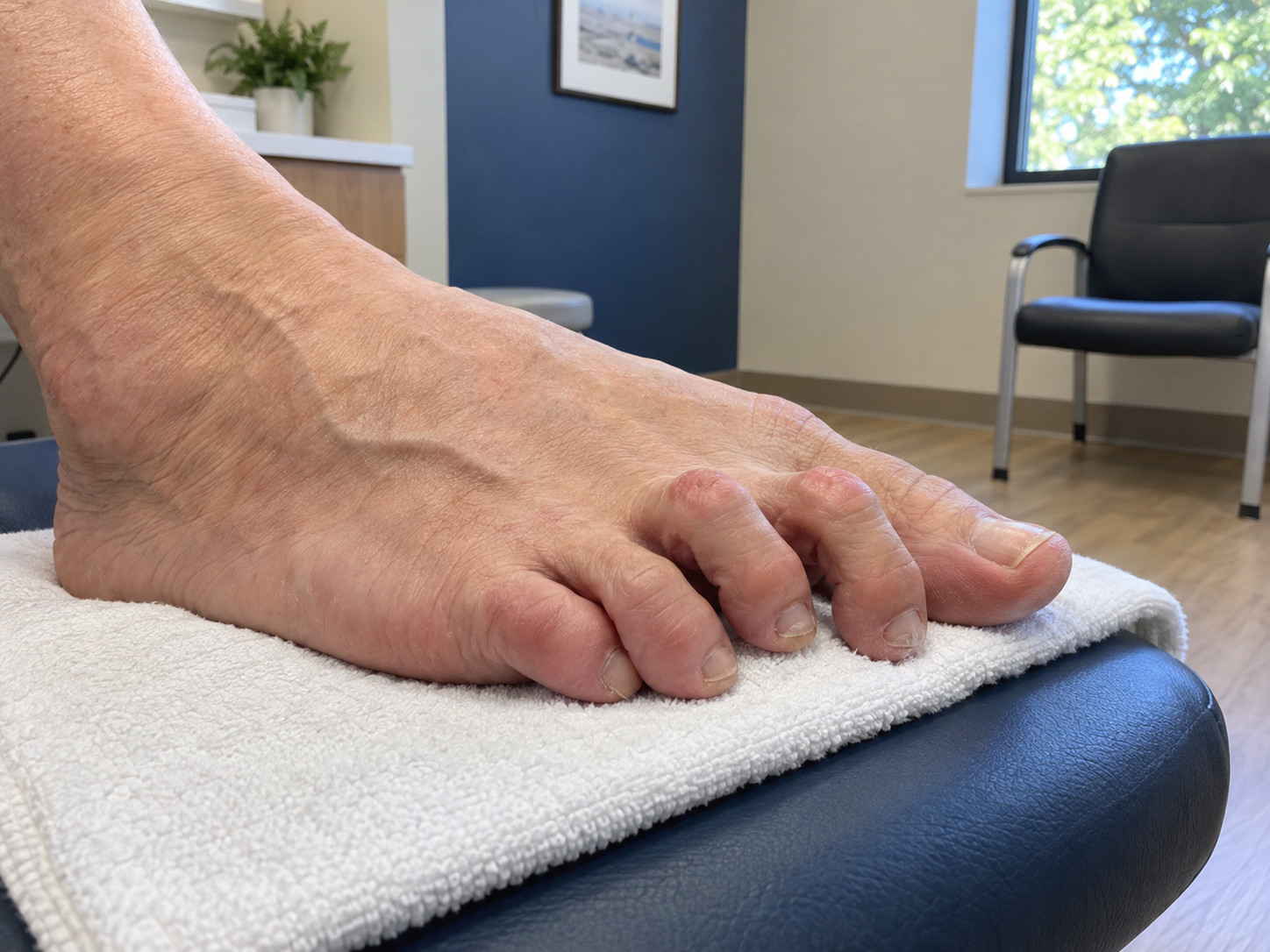
Have you noticed that one or more of your toes are beginning to bend or curl instead of lying flat?
If your toes look unusually bent, rub against your shoes, or become painful when walking, you may have a condition called hammertoe.
Hammertoes are common foot deformities that can develop gradually and become increasingly uncomfortable over time.
At Vargas Foot Specialists in Sugar Land, TX, Dr. Marco A. Vargas evaluates toe deformities and helps patients understand their treatment options, including conservative care and surgical treatment when appropriate.
A hammertoe occurs when a toe develops an abnormal bend at its middle joint, causing it to resemble a hammer.
The condition most commonly affects the second, third, or fourth toes.
In the early stages, the affected toe may remain flexible and can sometimes be straightened manually.
As the condition progresses, the joint may become more rigid, making the toe increasingly difficult to straighten.
Hammertoes can cause discomfort because the bent toe may rub against the inside of a shoe, creating pressure on the top or tip of the toe.
Hammertoes often develop because of an imbalance between the muscles and tendons that control toe movement.
Several factors may contribute to this imbalance.
Some people inherit foot structures that make them more likely to develop hammertoes.
For example, certain toe lengths or mechanical imbalances may increase pressure on the smaller toes.
Shoes with narrow toe boxes can force the toes into cramped positions.
Although footwear is not the only cause of hammertoes, repeated pressure from poorly fitting shoes may aggravate the condition and contribute to discomfort.
Certain forms of arthritis can affect the joints and soft tissues of the toes, potentially contributing to changes in their alignment.
Trauma to the toes or surrounding structures may also contribute to abnormal toe positioning.
Recognizing symptoms early can help you seek appropriate care before discomfort becomes more limiting.
The most recognizable sign is an abnormal bend in the middle joint of the toe.
The raised portion of the toe may rub against footwear, causing irritation and tenderness.
Repeated friction can lead to thickened skin on top of the toe or near its tip.
Pressure around the affected joint may cause localized inflammation.
As the condition becomes more rigid, the toe may lose some flexibility.
Treatment depends on whether the affected toe is flexible or rigid, how much pain it causes, and whether other foot problems are present.
For patients with mild or flexible hammertoes, conservative treatment may help reduce discomfort and manage pressure.
Choosing footwear with enough room for the toes can help reduce rubbing and irritation.
Shoes with a deeper toe box may be particularly helpful when the affected toe is elevated.
Toe pads or other protective devices may help reduce friction between the toe and the shoe.
However, they should be used carefully to avoid creating additional pressure.
For selected patients, custom orthotics may help address foot mechanics and redistribute pressure.
Although orthotics do not permanently straighten a rigid hammertoe, they may improve comfort when the condition is associated with other mechanical foot problems.
Certain exercises may help maintain flexibility and support foot function, especially when the deformity is still flexible.
Your podiatrist can determine which exercises are appropriate for your individual condition.
Surgery may be considered when hammertoes become rigid, cause persistent pain, or significantly interfere with daily activities despite appropriate conservative treatment.
Depending on the severity of the deformity, surgical procedures may involve releasing or repositioning soft tissues, correcting the affected joint, or addressing associated structural problems.
Not every patient with hammertoes needs surgery.
A podiatrist can explain the potential benefits, limitations, risks, and expected recovery associated with different treatment approaches.
Some hammertoes remain relatively stable, while others gradually become more rigid.
As the condition progresses, pressure against footwear may lead to persistent corns, calluses, pain, or difficulty finding comfortable shoes.
Patients with diabetes, neuropathy, or circulation problems should be particularly attentive to areas of pressure or skin breakdown.
An early evaluation may help identify ways to reduce discomfort and protect the affected toes.
If your toes are curling, becoming painful, or rubbing against your shoes, a podiatrist can evaluate the underlying cause and recommend an appropriate treatment plan.
At Vargas Foot Specialists, Dr. Marco A. Vargas, DPM, FACFAS, DABFAS, is a double board-certified podiatric surgeon who provides evaluation and treatment for a range of foot and ankle conditions.
Whether you are looking for hammertoe treatment in Sugar Land, a podiatrist near me, or a foot specialist in Houston, our team is here to help you understand your options.
We welcome patients from Sugar Land, Houston, Katy, Richmond, Missouri City, Stafford, Rosenberg, and nearby communities throughout Fort Bend County, Harris County, and Brazoria County.
Vargas Foot Specialists
4655 Sweetwater Blvd, Suite 650
Sugar Land, TX 77479
Call (281) 313-0090 to schedule your appointment.
¿Has notado que uno o varios dedos de tus pies están doblados o que te molestan al usar zapatos?
Esta condición se conoce como dedos en martillo y puede causar dolor, callosidades y dificultad para caminar cómodamente.
En Vargas Foot Specialists, el Dr. Marco A. Vargas es bilingüe, tiene raíces familiares colombianas y trabaja con un equipo latino comprometido con brindar una atención cercana a nuestra comunidad hispana.
Ofrecemos atención en inglés y español para pacientes de Sugar Land, Houston, Katy, Richmond, Missouri City, Stafford, Rosenberg y comunidades cercanas.
Si tienes dolor o cambios en la forma de tus dedos, una evaluación podológica puede ayudarte a conocer las opciones de tratamiento disponibles.
Llámanos al (281) 313-0090 y agenda tu cita. ¡Será un gusto atenderte en español!

0 Comments